


- By Ali Greplova
- 5. 4. 2026
- Africa
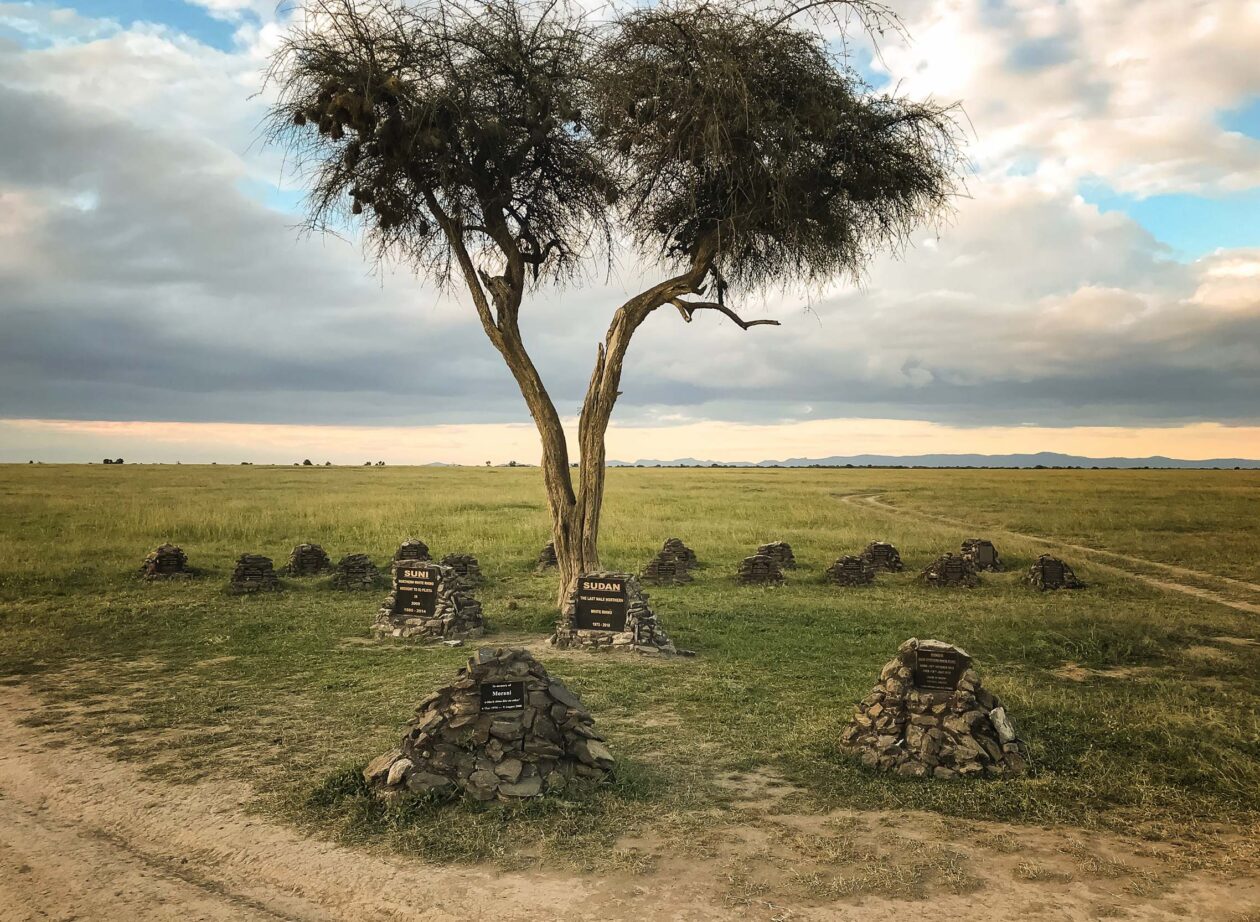
You are standing at a stone memorial in Kenya’s Ol Pejeta Conservancy, reading a name carved into rock. Sudan.
Sudan. The last male northern white rhino. 1973–2018.
Armed rangers guard your back. Before you — silence. And then it hits you: the tears are not for the death of one animal. They are for what we, as a species, managed to destroy.
But Sudan’s story is not only about loss. It is a story of how tenacious the will to save what we nearly let disappear can be. And that story began in a small Czech town called Dvůr Králové.
Rescue from the Shambe Marshes — and Words That Sting
1975. In the Shambe region of what was then Sudan, in marshland torn apart by civil war, a team led by Dvůr Králové Zoo director Josef Vagner captured six northern white rhinoceroses — two males and four females. One of them was a roughly two-year-old calf that would be named Sudan.
Vágner faced immediate criticism. Environmentalists and parts of the scientific community accused him of exporting rare, disappearing African animals to Europe. The numbers at the time suggested around 700 individuals remained in the wild — and capturing two calves for a zoo seemed to many like an unacceptable compromise.
Vágner responded with a factual argument that proved prophetic: Africa’s large fauna was heading for catastrophe. In many countries, due to poor protection and civil wars, nothing would remain. He was right. The last known wild northern white rhinos were poached on the border of the Democratic Republic of Congo in 2004.
Had we listened to those voices calling for “purity” — for leaving the animals in a nature that could not protect them — the BioRescue project would not exist today. There would be no embryos, no Nájin, no Fatu, not even the smallest shred of hope. Vágner’s decision was painful. And it was necessary.
It is a kind of humility — but of a different kind. Humility before the fact that reality is more complex than our convictions. That sometimes the right decision is the one that, from the comfort of a keyboard, appears immoral.
34 Years in Dvůr Králové
Under Vágner’s leadership, Dvůr Králové Zoo became the only place in the world where the northern white rhinoceros successfully bred in captivity. Sudan was the father of daughter Nájin (born 1989) and female Nabire (born 1983, died at Dvůr Králové in 2015). Nájin later gave birth to Fatu (born 2000). These two females — mother and daughter — are today the only living northern white rhinoceroses on the entire planet.
But breeding gradually stopped. The rhinos aged, natural mating failed. And then a bold — and once again controversial — decision was made.
Return to Africa: A Bet on Nature
Dvůr Králové Zoo director Dana Holečková pushed through the transfer of four rhinos back to Africa in 2009. Sudan, Suni, Nájin and Fatu were moved to Kenya’s Ol Pejeta Conservancy. The theory was simple: African sun, natural vegetation and free movement across hundreds of hectares might reawaken instincts suppressed by years of European captivity.
They arrived on 20 December 2009. Shortly after landing, the clouds broke and rain poured down. Sudan lifted his head to catch the scent of rain and immediately began rolling in the mud. It was his first African mud bath since he had left the continent as a two-year-old.
But natural mating ultimately failed. Male Suni died of natural causes in 2014. Sudan was now truly the last male on the planet.
The World’s Most Eligible Bachelor
The world’s media seized on Sudan. Tinder created a profile for him with the tagline „Most eligible bachelor in the world“ proceeds went to research. Photographer Ami Vitale of National Geographic, who had known him for years, described him as a quiet creature with a majestic bearing. He was a being who had survived capture, transport halfway across the world, decades in captivity and a return to the wild — and his personality continued to define him as a majestic creature.
Armed guards watched over him 24 hours a day, because his horn would have earned poachers more than a decade’s wages. Protection included transmitters in his horns, watchtowers, fences, drones, guard dogs and armed rangers around the clock.
In his final months he suffered from infections in his right rear leg and the general frailty of age. He was 45 years old. On 19 March 2018 Ol Pejeta’s veterinarians, in consultation with experts from Dvůr Králové, made the decision to euthanise him to prevent further suffering. His final moments were spent with his keeper Joseph Wachira, who held his head. Then the rain came — just as it had on the day he arrived in Africa nine years before.
What Remained: Science That Refuses to Surrender
And this is where the story truly begins to get interesting.
While Sudan was still alive, scientists collected his genetic material. Today the BioRescue project is underway — an international consortium led by Germany’s Leibniz-IZW and coordinated by Dvůr Králové Zoo. Since the first egg collection in August 2019, the team has reached a remarkable milestone: by 2025, over 35 northern white rhinoceros embryos had been created, cryopreserved in laboratories in Berlin and Cremona.
The embryos are created by combining eggs from female Fatu with frozen semen from the deceased males — Sudan and Suni. In September 2023 came a world first: the first ever successful embryo transfer in a rhinoceros — a surrogate mother (a southern white rhino) remained pregnant for seventy days following IVF. She died from an unrelated infection, but the foetus was healthy. Proof of concept confirmed.
Since July 2024, embryo transfers of pure northern white rhinoceros embryos into surrogate females at Ol Pejeta have been ongoing. No successful birth yet, but every attempt yields data. Science works exactly like this — not in a straight line, but with tenacity.
The goal is clear: the reintroduction of the northern white rhinoceros into its original range in Africa.
On Humility — and Those Who Have None
I’ll admit something. After thirty years in the bush, I am still surprised by how many people know exactly how we should treat nature — without ever having experienced it in any way other than through a computer screen.
I think of the Serengeti. Of a silence that lasts for hours. Of the moment when an elephant passes thirty centimetres from your vehicle and doesn’t spare you a glance. Of a rhinoceros grazing on a distant slope, completely unaware that you exist.
Humility arrives on its own out there. It comes when you understand how small you are. How fragile everything you see is. How easily it could all disappear.
And then you come home and read a comment: “People like you are the problem. Leave those animals alone.”
Had we listened to those voices — to moralising without knowledge, to pure theory without experience — the world would look different today. Without Vágner, the northern white rhinoceros would most likely have gone extinct sometime in the 1980s or 1990s, when a wave of poaching wiped out entire populations across central Africa. Without Holečková and her courageous transfer, the genetic material for BioRescue would never have existed. Without the keepers at Ol Pejeta, who spend more time with these animals than with their own children, Nájin and Fatu would long be gone.
All of these decisions were controversial. All of them faced criticism. And all of them proved to be right.
For me, humility means admitting that I do not know everything. That the reality in the field is more complex than my convictions. That I must first learn — to see, to observe, to listen — and only then to judge.
The photographs I bring back from Africa are not trophies. They are records. Testimony to what exists. And every interest, every visit, every photograph — that is an argument for continuing conservation. It is a voice that says: this creature has value.
Sudan Today
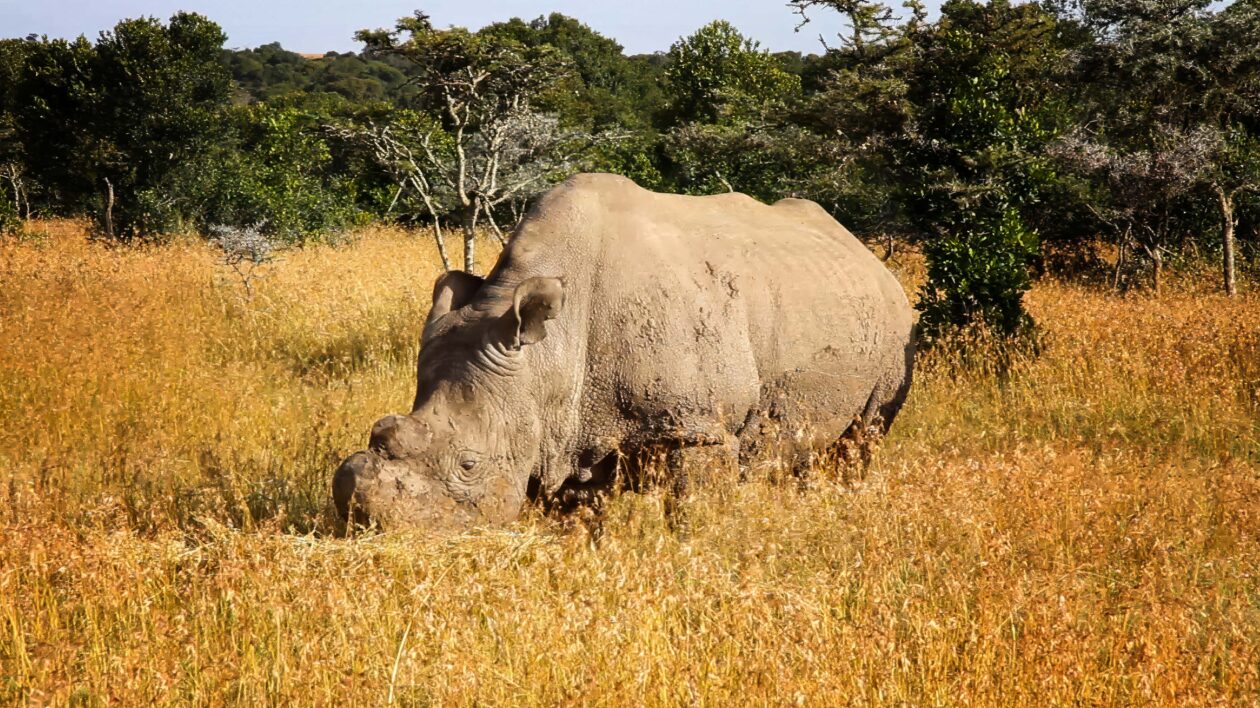
Nájin and Fatu graze at Ol Pejeta under the Kenyan sun. Somewhere in a Berlin laboratory, more than thirty-five embryos wait in liquid nitrogen. And a team of scientists from the Czech Republic, Germany, Kenya and Italy works every day toward the moment when Sudan may have great-grandchildren.
The story is not over yet.
Photography: Lengai101 / Wikimedia Commons / CC BY 3.0 (edited) + personal archive Ali Greplová
Sources: BioRescue consortium (biorescue.org), Leibniz-IZW Berlin, Ol Pejeta Conservancy, Time / Ami Vitale (2018)
