



- By Ali Greplova
- 25. 7. 2026
- Africa
- Comments:21
The story of František Vladimír Foit, Irena Foitová, and Jiří Baum — by Ali Greplova
Life is sometimes deeply unfair…. They say what we send out into the world comes back to us. That isn’t always true — and that’s exactly why I want to tell this story: about people whose names you’ve probably never heard, but who deserve to be remembered.
Most Czechs know the names Hanzelka and Zikmund. Few know that sixteen years before them, a sculptor named František Vladimír Foit and a zoologist named Jiří Baum drove across Africa — and that Hanzelka and Zikmund actually visited Foit for advice before their own expedition. Their story nearly vanished from Czech history altogether.
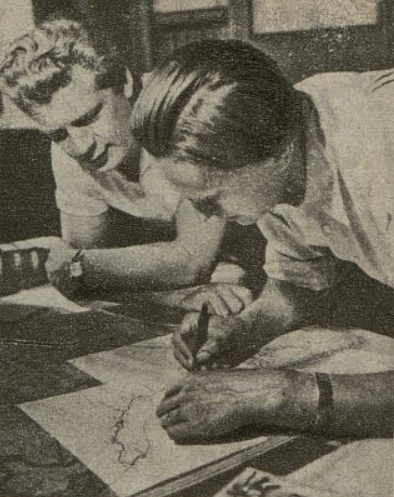
In 1947, Jiří Hanzelka and Miroslav Zikmund set out on a journey that turned them into national legends. To this day, they’re often described as “the first people in the world to drive across Africa by car.” That’s not accurate — that honor belongs to Chaplin and Stella Court Treatt, a married couple who drove from Cape Town to Cairo in 1924–1926. The first Czechoslovaks to make a comparable crossing were, sixteen years before Hanzelka and Zikmund, sculptor František Vladimír Foit and zoologist Jiří Baum, who drove from Cairo to Cape Town. Hanzelka and Zikmund even sought Foit’s advice before setting out themselves. And yet Foit was almost entirely forgotten.
So was Jiří Baum. He died in a concentration camp in Warsaw — his role in the anti-Nazi resistance escaped the Gestapo’s notice; he was arrested for being Jewish.
This is their story — and the story of the people around them: Foit’s wife Irena, and their daughter Regina.
Who was František Vladimír Foit
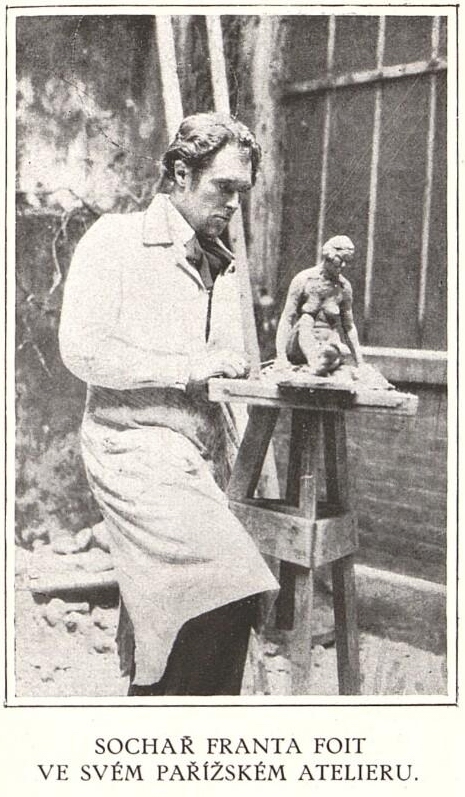
He was born on 2 November 1900 in Tábor, into the family of a successful stonemason and businessman, Ferdinand Foit — owner of the Mrákotín stone quarries and a senator for the Agrarian Party. He spent his childhood in Doupí, near Telč. He studied sculpture in Hořice, in Dresden under Professor Wrba, and in Paris under Bourdelle, where, by his own account, he became obsessed with the African collection at the Musée de l’Homme. He was an impulsive man — he boxed, had been through a turbulent first divorce, and had a police record of personal disputes.
The First Journey: 1931 — the one everyone forgot
In April 1931, he set out with zoologist Jiří Baum — still unmarried at the time — on an expedition backed by Charles University’s Institute of Anthropology and supported by the Tatra car company, which provided a Tatra 12. From Alexandria, along the Nile through Egypt, Sudan, Khartoum, and Stanleyville (today’s Kisangani) in the Belgian Congo, then via Lake Albert into Uganda and Nairobi, Kenya — from where they attempted to climb Kilimanjaro, reaching an altitude of 5,500 meters. They continued through what was then Northern Rhodesia to Victoria Falls, and finally to Cape Town in the Union of South Africa. They returned to Prague in December 1931. Foit wrote a two-volume book about the journey, Autem napříč Afrikou (“By Car Across Africa,” 1932–1934), and made a film, K mysu dobré naděje (“To the Cape of Good Hope”).
Irena and the Second Journey — the one nobody forgot, because they never came back
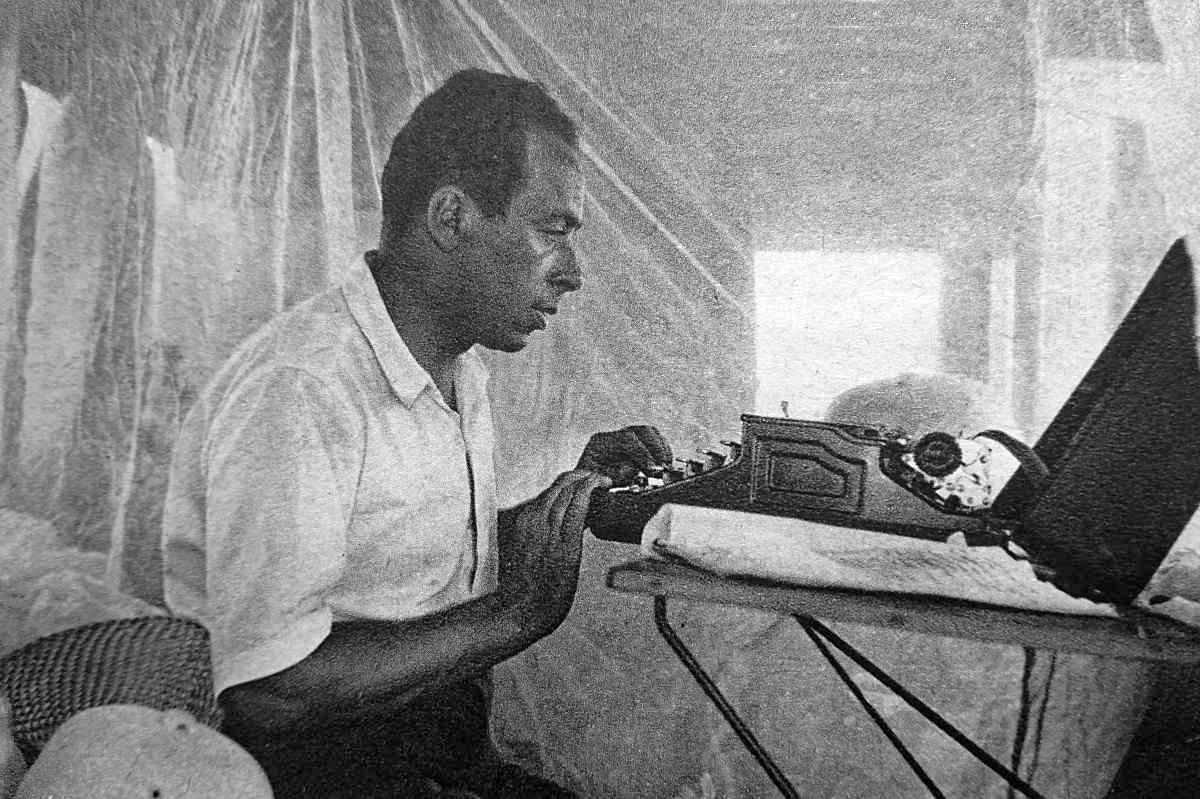
In the meantime, Foit married for the second time, to Irena (b. 1913). On 3 November 1947, the couple set out on a second African expedition — this time in a Tatra 57B nicknamed “Hadimrška.” They left their eight-year-old daughter Regina (born 1939) with Irena’s parents, planning to be back within a year. Their route led from North Africa through Algeria and the Sahara (including the Ahaggar mountains) south into Nigeria, then Cameroon, French and Belgian Congo, all the way to South Africa, before turning north again toward Nairobi. František sculpted busts of African faces directly in the field, Irena assisted him, and together they recorded hundreds of samples of local music.
In June 1950, tensions boiled over around the lifelike busts of African heads that the Foits were sending home: a crowd in Leopoldville (today’s Kinshasa) — by Irena’s own account, some fifteen thousand people — surrounded them, shouting “mitumbula” — cannibals. The Foits were accused not only of cannibalism but of inciting communist revolution among the local population, and were held under house arrest for a time. Irena, alone in the city at the time, was rescued from the enraged crowd by an unknown American woman who pulled her into her car.
Why the Foits never returned to Czechoslovakia
In February 1948, a communist coup took place in Czechoslovakia. The Foit family’s property — the quarries, the land, everything built up over generations — was nationalized. Returning home became undesirable.
“We were victims of politics. We couldn’t go back, we were unwanted. After 1948 we lost everything we owned. We had a stoneworking factory near Telč and some farmland,” Irena Foitová recalled in 2003. And she added what hurt her most: “Because of the politics that pursued us even in Africa, I essentially lost my daughter too. I was lucky to have wonderful parents who raised her. But I lost the best years of her life.”
(More recent research by historian Pavel Bek of the Tatra Truck Museum in Kopřivnice, published in 2026, offers a different account — a personal conflict with the Czechoslovak consul in Kenya over passports. Irena recalled that during their internment in the bush, a consul from the Czechoslovak embassy came to ask them to hand over their passports, promising to renew them back home — they never saw the passports or the consul again. Irena’s own testimony about political persecution, however, is unambiguous, and it comes from someone who lived through the events themselves.)
One thing is certain: while Hanzelka and Zikmund returned to Prague in November 1950 to crowds welcoming them home, the Foits were, at that very moment, hiding in a hut in the bush — where authorities had sheltered them for seven months for their own safety, after a fifteen-thousand-strong crowd in Leopoldville accused them of cannibalism and their sculptures sparked unrest that led to a state of emergency in the city. And back home, a regime waited that would rather erase their existence than acknowledge it.
Life Between Tanzania and Kenya, and a Reunion Years Later
After seven months in isolation, the Foits settled in 1952 in what was then Tanganyika (today’s Tanzania), where they lived for ten years in Moshi and Marangu — both towns at the foot of Kilimanjaro. Only later did they move to Nairobi, Kenya, where František taught at Kenyatta College and created a fountain sculpture, “Thirst for Knowledge,” in front of the university. They were reunited with their daughter Regina for the first time in 1968 — after more than twenty years apart. Authorities had allowed her to visit her parents in Africa. “We stood facing each other at the airport and just looked at one another,” Irena recalled.
The End, in Yugoslavia
Through a contact with the director of the Slovene Ethnographic Museum, the Foits moved to Velenje, Yugoslavia, in 1971, in exchange for donating their entire collection. Less than a month after their arrival, František died in a car accident. Irena remained in Velenje, managing the collection, for almost 25 more years, until the mid-1990s, when she returned to Telč to be with her daughter. She died in 2005; Regina died in 2018, without children of her own. Both are buried in the family grave in Telč, to which František’s remains were also transferred.
Jiří Baum — Zoologist, Traveler, Resistance Fighter
He was born on 20 September 1900 in Prague. He studied at a business academy and later at the Faculty of Science at Charles University, where in 1928 he earned his doctorate with a dissertation on the spiders of Bohemia. He spoke eleven languages, traveled across five continents, and had dozens of species named after him. Baum, with whom Foit discovered Africa for Czechoslovaks in 1931, was far more than a travel companion.
After the journey with Foit, he met his future wife, Růžena Fikejzlová. They first took shorter trips together — to Scandinavia and the Baltics, then to Spain and Morocco. From December 1934 to December 1935, they undertook a year-long journey around the world in a custom-built camper Tatra 72, built by the Uhlík coachworks — by ship from Italy to Australia, then via Japan and Hawaii to the United States, before returning to Czechoslovakia through the Panama Canal, London, and the Netherlands. Baum wrote a book about the trip, Kolem zeměkoule autem a lodí (“Around the Globe by Car and Ship”), while Růžena, writing under her maiden name Fikejzlová, published her own travelogues about Australia and Japan.
🚐 The Camper Tatra 72 — a Custom Expedition Vehicle for a Journey Around the World
For his journey around the world, Baum had a custom living compartment built onto a Tatra 72 chassis at the Oldřich Uhlík coachworks in Prague — essentially a forerunner of the modern camper van, sixty years before such vehicles became commonplace.
- Chassis: three-axle (six-wheel), with drive on both rear axles — far better off-road than most vehicles of the era
- Engine: air-cooled four-cylinder, 1,981 cc, 22 kW (30 hp)
- Wheelbase: 3,820 mm
- Chassis weight: 908 kg
- Top speed: 65 km/h
- Living compartment: a small kitchenette and a darkroom for developing photographs on the road
- The Uhlík coachworks also built bodies for aristocracy (the Lobkowicz family) and marques such as Bugatti and Rolls-Royce — Baum’s vehicle was one of their most unusual commissions
Their last major journey together was, once again, to Africa — this time to the south (1938–1939). In 1941, their son was born.
During the war, his entire immediate family joined the resistance alongside him. His sister, Anna Pollertová, was a key figure in the PVVZ resistance organization — she found hiding places for the persecuted, funded resistance activities from her own money, and cared for the families of imprisoned comrades. The Nazis executed her on 19 January 1945, in Berlin-Plötzensee. Baum’s wife Růžena also took part in the underground work. She survived the war, raised their son Petr, and went on to publish her own travelogues as well as her husband’s works. She died in 1975 in Prague. Their son Petr emigrated to Australia with his family in 1985, where he still lives today and maintains an extensive digitized archive of his father’s photographs.
Baum himself was arrested on 10 June 1943. He passed through the prison on Charles Square and Terezín’s Small Fortress before being sent to Auschwitz, and finally to a concentration camp in Warsaw, where he died in January 1944. Today, he too remains almost unknown outside a narrow circle of travel enthusiasts — though at least he has his own Stolperstein in Prague.
ℹ️ What is a Stolperstein
A Stolperstein (“stumbling stone”) is a small brass cobblestone inscribed with the name, birth date, and fate of a victim of Nazism, installed by artist Gunter Demnig into the pavement outside the person’s last freely chosen home. There are now more than 100,000 of them across Europe. Jiří Baum’s stone is set into the pavement on Přemyslovská Street in Prague.
Legacy
The collections from both expeditions are now scattered between the Hrdlička Museum of Man and the Náprstek Museum in Prague, the Telč branch of the Vysočina Museum in Jihlava, and the Velenje Museum in Slovenia, which holds more than 10,000 photographs and over 200 masks. Only in recent years has Foit’s story begun to resurface — exhibitions in Telč (2021, 2023), in Velenje, Slovenia, and this year at the Tatra Truck Museum in Kopřivnice (running through 22 November 2026). History remembered, for eighty years, the men who came after him. František Vladimír Foit and Jiří Baum were among the first. Perhaps it’s time it remembered them too.
Photography: AI-generated illustration (Grok) — an artistic interpretation, not a period photograph; period portraits of Foit, Baum, and Hanzelka and Zikmund — Wikimedia Commons, Public Domain / CC BY-SA 4.0 license
Sources: cs.wikipedia.org — František Vladimír Foit, Jiří Baum; Vysočina Museum Jihlava (mgvysociny.cz); Velenje Museum / Slovene Ethnographic Museum (muzej-velenje.si, etno-muzej.si); National Museum Prague — Náprstek Museum (nm.cz); idnes.cz — Ilona Zelníčková (2021), Tomáš Málek (2026); rtvslo.si (2023); Stolpersteine CZ (stolpersteinecz.cz); Czech Radio Regions — Leo Pavlát (2020); Czech Ministry of Foreign Affairs, Embassy in Ljubljana
Foit and Baum weren’t the only Czechs Africa took hold of. See where the journey continues today.
